

What Is an NDIS Registered Provider? 2026 Guide
If you’re trying to access disability supports in Australia, understanding what is an NDIS registered provider is one of the most practical things you can do. Many participants assume that “registered” simply means “better,” but the reality is more nuanced. Registration signals regulatory oversight, not automatic quality. This guide breaks down exactly what registration means, how it differs from unregistered providers, what the 2026 policy changes mean for you, and how to find the right provider for your specific needs and funding type.
Table of Contents
- Key takeaways
- What is an NDIS registered provider?
- Registered vs. unregistered providers: the real differences
- Benefits and limitations of NDIS registration
- How to find and choose the right NDIS registered provider
- Registration changes in 2026 and beyond
- My honest take on the NDIS registration system
- Find disability support products that work with your NDIS plan
- FAQ
Key takeaways
| Point | Details |
|---|---|
| Registration means oversight | NDIS registered providers are audited by the NDIS Quality and Safeguards Commission and must meet strict practice standards. |
| Funding type determines choice | Agency-managed participants can only use registered providers; self-managed and plan-managed participants have more flexibility. |
| Registration is not a quality guarantee | An unregistered provider is not illegal and may deliver excellent support; due diligence still matters. |
| 2026 brings mandatory changes | From July 2026, registration becomes mandatory for personal care and daily living supports classified as high risk. |
| Costs vary significantly | Initial registration can cost between $2,000 and $15,000+, which is why some smaller providers remain unregistered. |
What is an NDIS registered provider?
An NDIS registered provider is any person, business, or organization that has been formally approved by the NDIS Quality and Safeguards Commission to deliver funded supports and services to NDIS participants. Registration is not simply filling out a form. It involves independent audits, suitability assessments, and a commitment to ongoing compliance requirements including incident reporting and worker screening checks.
The NDIS itself supports over 600,000 participants across Australia as of 2026, and the provider network is the backbone of how those participants access the supports written into their plans. Registered providers must adhere to the NDIS Practice Standards, which cover areas like person-centered support, privacy, and the prevention of violence and abuse. They also must follow the NDIS Code of Conduct, which applies to all workers delivering supports.
Who exactly can become a registered provider? The answer is broad. Sole traders, small businesses, non-profit organizations, and large corporations can all apply. What matters is not the size of the organization but whether it can meet the Commission’s requirements.
The registration process itself includes several distinct steps:
- Submitting an application through the NDIS Commission portal
- Undergoing a suitability assessment (covering criminal history, financial history, and key personnel checks)
- Completing an independent audit conducted by an approved quality auditor
- Meeting the relevant NDIS Practice Standards for the specific supports being delivered
- Receiving formal registration approval and appearing on the NDIS Provider Register
Registration typically lasts three years, after which providers must re-register and undergo another audit cycle. The type of audit (verification or certification) depends on the risk level of the supports being delivered. Higher-risk supports like behavior support or Specialist Disability Accommodation require a more intensive certification audit.
Pro Tip: If you are a participant trying to verify a provider’s status, you can search the official NDIS Provider Register on the NDIS Commission website. It is publicly accessible and shows current registration details for any provider.
Registered vs. unregistered providers: the real differences
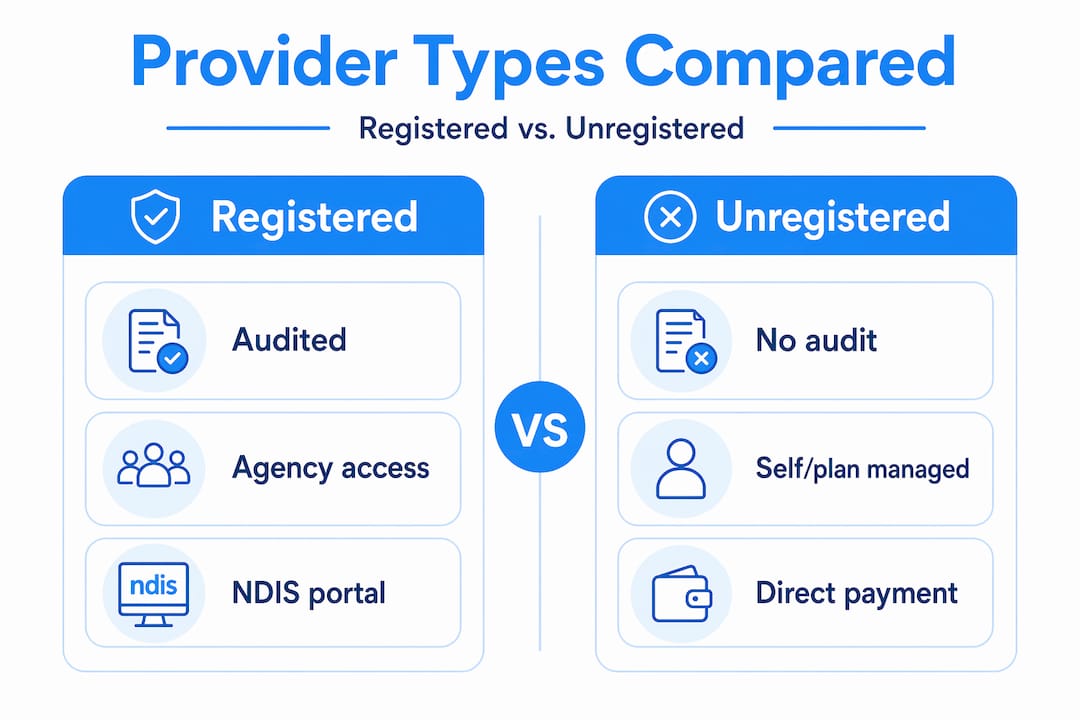
This is where most participants get confused, so it is worth being direct. The core difference between registered and unregistered NDIS providers is not about who delivers better support. It is about regulatory structure, audit requirements, and which participants each type can serve.
| Feature | Registered Provider | Unregistered Provider |
|---|---|---|
| NDIS Commission audit | Required | Not required |
| NDIS Code of Conduct | Mandatory | Mandatory |
| Serves agency-managed participants | Yes | No |
| Serves self-managed participants | Yes | Yes |
| Serves plan-managed participants | Yes | Yes |
| Pricing limits apply | Yes | Negotiable |
| Appears on NDIS Provider Register | Yes | No |
| Worker screening required | Yes (NDIS-specific) | General requirements |
About 70% of participants are agency-managed, which means the majority of the NDIS market is only accessible to registered providers. If you are agency-managed, your plan is administered directly by the NDIA, and you must use registered providers for all your supports. This is a significant practical constraint.
Self-managed and plan-managed participants have more freedom. Self-managed and plan-managed participants represent roughly 30% of the market, and they can choose unregistered providers as long as those providers deliver supports that align with their plan goals.
A few things that are often misunderstood:
- Unregistered does not mean illegal. Unregistered providers operate under general Australian consumer law and safety regulations; they simply are not subject to NDIS-specific audits.
- Both registered and unregistered providers must follow the NDIS Code of Conduct. This is a non-negotiable obligation regardless of registration status.
- Registration is mandatory for certain high-risk supports. Providers delivering Specialist Disability Accommodation, behavior support, and early childhood supports cannot operate unregistered under any circumstances.
The distinction between registered and unregistered providers is often misread as a quality signal. It is not. It is a regulatory signal. A small, unregistered allied health professional with 20 years of experience may deliver far better outcomes than a newly registered organization with a polished website.
Benefits and limitations of NDIS registration
For providers, the decision to register is a genuine business calculation. For participants, understanding this dynamic helps you make smarter choices about who you work with.
The benefits of registration are real and significant:
- Access to agency-managed participants. Since this group represents the majority of the NDIS market, registration opens up the largest portion of potential clients.
- Credibility and trust. Registration signals that a provider has passed independent scrutiny, which matters to many participants and their families.
- Regulatory protection for participants. Registered providers are subject to complaint mechanisms through the NDIS Commission, giving participants a formal pathway if something goes wrong.
- Ability to deliver restricted supports. Certain high-risk or specialized supports can only be delivered by registered providers, regardless of how a participant manages their plan.
The limitations are equally real. Initial registration costs range from $2,000 to over $15,000, and that is before accounting for the ongoing compliance burden of incident reporting, worker screening renewals, and re-auditing every three years. For small providers or sole traders, this cost can be prohibitive.
Some smaller providers deliberately remain unregistered to avoid these costs, even though it limits their market. This is a rational business decision, not a red flag. The key insight for participants is that registration provides a regulatory trust mark but the cost-benefit balance varies widely depending on the provider’s size, services, and client base.

Pro Tip: If you are a small provider considering registration, start by identifying whether any of your current or target clients are agency-managed. If they are not, and you do not plan to deliver high-risk supports, the financial case for immediate registration may be weaker than you think.
There is also a less-discussed issue worth flagging. The NDIS payment portal can auto-approve claims from registered providers, which has raised concerns about financial transparency. Registration does not automatically mean every claim or service is being delivered appropriately. Participants and plan managers still need to review invoices carefully.
How to find and choose the right NDIS registered provider
Finding a registered provider is straightforward once you know where to look. Choosing the right one takes a bit more thought.
- Search the NDIS Provider Register. Go to the NDIS Commission website and use the provider register search tool. You can filter by location, registration group, and support type. This confirms whether a provider is currently registered and what services they are approved to deliver.
- Check what registration groups they hold. A provider registered for personal care is not automatically approved to deliver behavior support. Match their registration groups to the specific supports in your plan.
- Read reviews and ask for references. Registration tells you a provider met a compliance threshold. Reviews and references tell you whether they actually show up on time, communicate well, and respect participant choices.
- Ask about their experience with your specific disability or support need. A provider registered for daily activities may have deep experience with one type of disability and very little with another.
- Clarify pricing before you start. Registered providers must follow NDIS price limits, but you should still confirm what you will be charged for each support item and whether there are any additional fees.
- Understand your plan management type first. If you are agency-managed, you must use registered providers. If you are self-managed or plan-managed, you have more options and should weigh both registered and unregistered providers based on fit and quality.
When something feels off during initial conversations, trust that instinct. Red flags include vague answers about what services are included, pressure to sign long-term agreements quickly, or reluctance to provide written service agreements.
Registration changes in 2026 and beyond
The NDIS registration landscape is shifting in ways that directly affect both participants and providers. These are not minor administrative tweaks.
From July 2026, mandatory registration extends to personal care and daily living supports that are classified as high risk. This means providers who have been delivering these supports without registration will need to either register or stop delivering those specific services to NDIS participants.
Key developments to watch:
- The government has signaled further registration expansions planned for 2027, targeting a broader range of support categories.
- The push for tighter registration is directly linked to efforts to reduce fraud and improve financial transparency across the scheme.
- Some providers are expected to exit the market rather than absorb registration costs, which could reduce options in certain regions or for certain support types.
- Participants who currently use unregistered providers for supports that will become restricted should start having conversations with those providers now about their registration plans.
The practical implication for participants is clear. If you rely on an unregistered provider for personal care or daily living supports, you need to check whether they will be affected by the July 2026 changes. Do not wait until your current provider can no longer legally serve you.
My honest take on the NDIS registration system
I’ve spent years working alongside people navigating the NDIS, and the registration question comes up constantly. What I’ve learned is that participants often anchor too heavily on registration status as a proxy for quality. I understand why. When you’re trusting someone with your daily care or your child’s development, you want reassurance. Registration feels like that reassurance.
But I’ve seen registered providers deliver inconsistent, impersonal support, and I’ve seen unregistered allied health professionals change lives. The audit process confirms that a provider has the right policies and paperwork. It does not confirm that their workers are compassionate, skilled, or genuinely invested in your outcomes.
What I’d actually recommend is this: use registration as a starting filter, not a final decision. It tells you a provider has cleared a baseline. After that, the questions you ask, the references you check, and the first few interactions you have will tell you far more than any registration certificate.
The 2026 changes are a step in the right direction for participant safety, particularly for high-risk supports. But the real protection comes from informed participants who know their rights, ask good questions, and don’t hesitate to switch providers when something isn’t working.
— Aamir
Find disability support products that work with your NDIS plan
If you’re an NDIS participant building out your support network, having the right equipment at home can make a significant difference to your daily independence. Dzsensory stocks a range of disability support products that are eligible for NDIS funding, from sensory tools to practical mobility aids. Whether you’re looking for a bed grip rail to improve safety getting in and out of bed, a foldable rollator walker for outdoor mobility, or a self-help pole for greater independence around the home, Dzsensory has options tested for safety and functionality. Browse the full range at the Dzsensory store and use your NDIS funding for products that genuinely support your goals.
FAQ
What is an NDIS registered provider?
An NDIS registered provider is a person, business, or organization approved by the NDIS Quality and Safeguards Commission to deliver funded supports to NDIS participants, having passed independent audits and met the NDIS Practice Standards.
Can I use an unregistered provider with my NDIS plan?
Yes, if you are self-managed or plan-managed. Agency-managed participants must use registered providers for all supports. Unregistered providers are not illegal; they simply operate outside the NDIS Commission’s audit framework.
How long does NDIS registration last?
NDIS registration is valid for three years, after which providers must re-register and complete another audit cycle to maintain their approved status.
Does being registered mean a provider is higher quality?
Not necessarily. Registration confirms a provider has met compliance and audit requirements, but it does not guarantee the quality of day-to-day support. Participants should still check reviews, ask for references, and assess fit independently.
What supports require a registered provider regardless of plan type?
High-risk supports including Specialist Disability Accommodation, behavior support, and early childhood supports require a registered provider regardless of how a participant manages their plan. From July 2026, personal care and daily living supports classified as high risk are also added to this list.
