

Claiming Sensory Products NDIS: Your 2026 Parent's Guide
If you’ve spent hours trying to figure out how to access NDIS funding for your child’s sensory tools, you are not alone. Claiming sensory products NDIS is one of the most confusing parts of managing a child’s plan, especially when the rules keep shifting. This guide cuts through the confusion. You’ll learn exactly which products qualify, how to prepare your evidence, how to submit your claim based on your plan type, and what to do when things go wrong. No guesswork, no generic advice.
Table of Contents
- Key Takeaways
- Claiming sensory products NDIS: what actually qualifies
- Preparing your claim: what to gather first
- How to submit your sensory product claim
- What to do when your claim is rejected
- Maximizing your NDIS sensory products funding
- My honest take on navigating NDIS sensory claims
- How Dzsensory makes NDIS purchasing straightforward
- FAQ
Key Takeaways
| Point | Details |
|---|---|
| Know your funding category | Most sensory products under $1,500 fall under Core Supports Consumables with no prior approval needed. |
| Evidence is everything | Therapist reports linking products to your child’s functional goals significantly improve approval rates. |
| Match your claim method to your plan | Self-managed, plan-managed, and NDIA-managed plans each have different submission steps. |
| 2026 rules are stricter | New legislation requires detailed documentation of how a product supports functional capacity. |
| Compare prices before purchasing | NDIS expects value for money, and overquoting can delay or derail your claim. |
Claiming sensory products NDIS: what actually qualifies
Before you submit anything, you need to know whether the product you want is actually fundable. The NDIS does not pay for everything that might help your child. It funds supports that are reasonable and necessary, meaning they must be directly related to your child’s disability and not something the general population would typically buy.
Sensory products for children with sensory processing challenges generally fall into two NDIS funding categories.
Core Supports (Consumables) covers lower-cost, everyday disability-related items. Think weighted blankets, tactile cushions, sensory fidget tools, chewable jewelry, and noise-canceling headphones. These are the products most parents are shopping for. Low-cost assistive technology under $1,500 per item sits within this category and does not require prior NDIS approval, which makes the process much faster.
Assistive Technology (AT) covers higher-cost items above $1,500, such as specialized sensory swings, sensory rooms, or complex communication devices. These require quotes, assessments, and often prior approval before you purchase.
Here is a quick breakdown of what is typically included versus excluded:
| Eligible sensory products | Not funded by NDIS |
|---|---|
| Weighted blankets and vests | General comfort items (non-disability-related) |
| Tactile cushions and seating aids | Standard household furniture |
| Sensory fidget and chew tools | Items for injury recovery or general wellness |
| Noise-canceling headphones (disability use) | Mainstream electronics not tied to disability need |
| Sensory swings and movement tools | Items covered by Medicare or other schemes |
The NDIS funds assistive technology that improves functional capacity but does not fund generic household tools or items related to injury recovery. If your child’s occupational therapist (OT) has recommended a product specifically to address sensory regulation, emotional dysregulation, or daily living challenges, you are on solid ground.
Preparing your claim: what to gather first
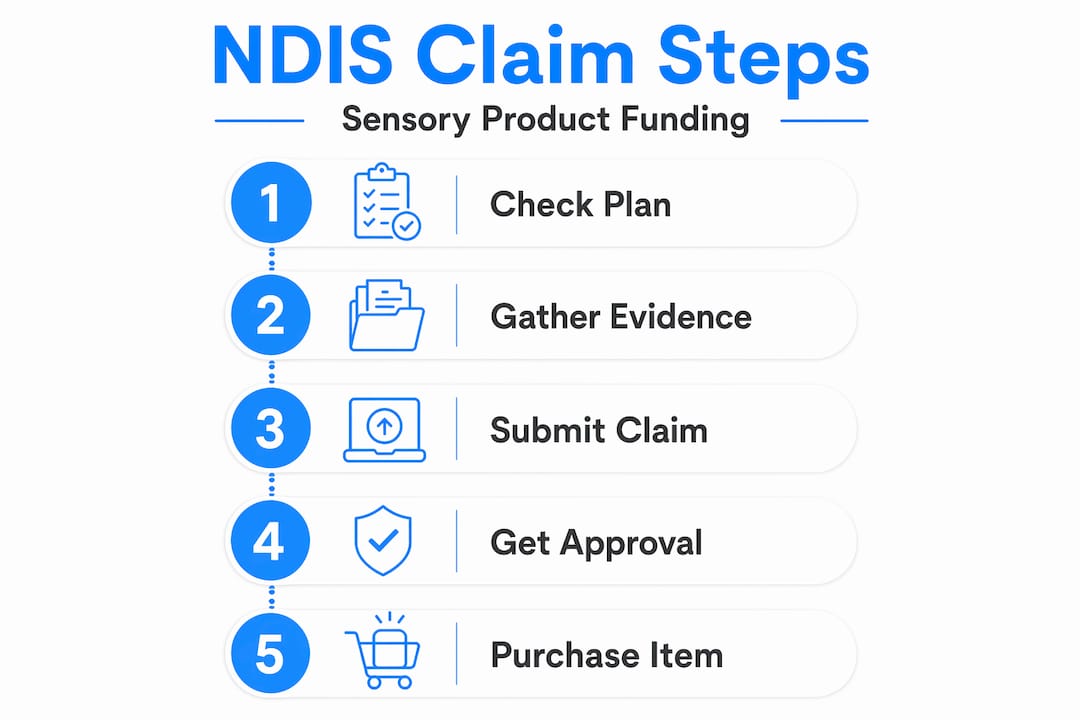
Getting your documentation right before you submit is the single biggest factor in whether your claim succeeds or stalls. Here is what you need to do.
Check your NDIS plan for available funding. Not every plan explicitly lists a Consumables line item, but most Core-supported participants can access it flexibly. Log into your myNDIS portal or contact your plan manager to confirm what is available and how much remains.
Connect the product to a functional goal. The NDIS does not fund products in isolation. Every item needs to connect to a goal in your child’s plan, such as improving self-regulation, supporting participation in school, or increasing independence in daily routines. If the connection is not obvious, your claim will likely be questioned.
Gather your supporting evidence. This is where most parents underestimate the work involved. You will need:
- A therapist report (OT, speech pathologist, or psychologist) recommending the specific product
- A functional assessment explaining how the product addresses your child’s disability-related needs
- Quotes from at least one NDIS registered provider
- Any previous trial reports or progress notes showing the product’s benefit
The 2026 NDIS legislative changes introduced a stricter functional capacity test and civil penalties for non-compliant claims. This means your therapist’s report cannot be vague. It needs to describe specifically how the product supports your child’s functional capacity, not just state that it “may help.”
Pro Tip: Keep a dedicated folder, physical or digital, for every piece of documentation related to your child’s NDIS plan. Include therapist invoices, product quotes, emails with providers, and copies of submitted claims. This saves enormous time during plan reviews and appeals.
How to submit your sensory product claim
The process differs depending on how your NDIS plan is managed. NDIS claims can be self-managed, plan-managed, or NDIA-managed, each with different submission procedures and paperwork requirements.
Self-managed plans
- Purchase the product from any provider, NDIS registered or not.
- Keep the original tax invoice showing the supplier’s name, ABN, date, item description, and amount.
- Log into the myNDIS portal and submit a payment request under the correct support category (typically Consumables).
- Upload your invoice and any supporting documentation.
- Reimbursement is typically processed within a few business days.
Plan-managed plans
- Purchase the product from any provider.
- Send the invoice to your plan manager with a note explaining which budget category it should come from.
- Your plan manager submits the claim to the NDIS on your behalf.
- You do not need to log into the portal yourself.
NDIA-managed plans
- You must purchase from a registered NDIS provider only.
- The provider submits the claim directly to the NDIS through the provider portal.
- You do not handle the paperwork, but you must confirm the purchase is within your plan’s approved supports.
For items over $1,500, prior approval is required regardless of your plan management type. You will need to submit a formal AT request, which includes a therapist assessment, product quotes from at least two providers, and a written justification of why this specific item meets your child’s needs.
Pro Tip: When your child needs a higher-cost sensory item, ask your OT to write the justification letter using the NDIS language of “reasonable and necessary.” Planners respond better to reports that mirror NDIS terminology than to clinical language alone.
Common mistakes to avoid:
- Submitting without a therapist recommendation for items above $500
- Using the wrong support category (Consumables vs. Assistive Technology)
- Purchasing from an unregistered provider when on an NDIA-managed plan
- Missing the connection between the product and a plan goal
What to do when your claim is rejected
Rejections happen, even with solid documentation. Understanding why helps you fix the problem quickly.
The most common reasons sensory product claims are denied include:
- The item is not considered “reasonable and necessary” for the child’s disability
- Insufficient evidence linking the product to a specific functional goal
- The product is seen as a general household item rather than a disability support
- The claim was submitted under the wrong budget category
- The price exceeds what NDIS considers value for money
“Persistence and documentation are your two most powerful tools. A rejection is not a final answer. It is a request for more information.”
When your claim is rejected, request a written explanation from the NDIS. This tells you exactly what evidence was missing. Then work with your child’s therapist to strengthen the documentation, specifically addressing the reason for rejection.
You have the right to request an internal review within three months of a decision. If that fails, you can escalate to the Administrative Appeals Tribunal (AAT). Most parents who succeed at appeal do so because they gathered stronger functional evidence the second time around. Consider reaching out to a disability advocate or NDIS support coordinator if you feel stuck. Many advocacy services are free.
Maximizing your NDIS sensory products funding
Getting approved is one thing. Spending your funding wisely is another.

The NDIS places significant weight on value for money, and some providers overquote simple items by a wide margin. Comparing quotes across providers is not just smart. It is expected. The Core Supports budget is typically flexible, meaning unspent funds from Assistance with Daily Life or Social and Community Participation can often be redirected to cover eligible consumables like sensory products.
Here are practical ways to stretch your funding:
- Request quotes from at least two providers before purchasing higher-cost items
- Check whether a lower-cost alternative meets the same functional need
- Ask your OT whether a product can be trialed before full purchase
- Use sensory diet strategies to identify which products your child actually uses consistently, so you don’t fund items that end up unused
- Review your plan budget quarterly so you know what is remaining before it expires
A tactile cushion is a good example of a low-cost sensory item that meets NDIS criteria without requiring prior approval. Products like this sit comfortably within the Consumables category and are straightforward to claim.
Pro Tip: Before your plan review, list every sensory product your child used in the past 12 months and what it helped them achieve. This becomes your evidence base for requesting continued or increased funding in the next plan.
My honest take on navigating NDIS sensory claims
I’ve worked with enough families going through this process to know that the biggest barrier isn’t the NDIS itself. It’s the gap between what parents know and what the system expects them to document.
The 2026 legislative changes have made this gap wider. The stricter functional capacity test means that a general OT recommendation no longer carries the weight it once did. You need specifics. Which function is impaired? How does this product address that impairment? What measurable outcome are you expecting?
In my experience, parents who treat their NDIS plan like a living document, updating evidence, tracking outcomes, and communicating regularly with their therapists, get far better results than those who submit once and hope for the best. The system rewards preparation. It also rewards persistence. A first rejection is not a reason to give up. It is a reason to go back to your OT with a clearer brief.
Advocate confidently. You know your child better than any planner does.
— Aamir
How Dzsensory makes NDIS purchasing straightforward
If you are ready to start purchasing sensory products with your NDIS funding, Dzsensory makes the process straightforward. The Dzsensory store carries a wide range of NDIS-aligned sensory products, from low-cost consumables to higher-cost assistive tools, all tested for safety and functionality. Whether your plan is self-managed, plan-managed, or NDIA-managed, Dzsensory supports all three claim types and provides the documentation you need for smooth reimbursement.
Products like the Sensory Nest Swing and the Sensory Star Kids Bed Tent are designed specifically for children with sensory processing challenges and align with NDIS Core Supports criteria. Browse the full range and shop with confidence knowing your funding is being put to real use.
FAQ
What sensory products can I claim through NDIS?
You can claim sensory products that are directly related to your child’s disability and meet the “reasonable and necessary” test. Common examples include weighted blankets, tactile cushions, sensory swings, noise-canceling headphones, and fidget tools.
Do I need prior approval to claim sensory products under NDIS?
Items under $1,500 classified as low-cost assistive technology within Core Supports Consumables generally do not require prior approval. Items over $1,500 require a formal Assistive Technology request with therapist assessment and quotes.
What evidence do I need for NDIS sensory product reimbursement?
You need a therapist report linking the product to your child’s functional goals, a functional assessment, and at least one provider quote. Since 2026, detailed functional evidence is required to satisfy the stricter capacity test.
Can I buy sensory products from any store using NDIS funding?
Self-managed and plan-managed participants can purchase from any provider, including non-registered stores. NDIA-managed participants must purchase from registered NDIS providers only.
What should I do if my NDIS sensory items claim is rejected?
Request a written explanation, then work with your therapist to address the specific reason for rejection. You can submit a request for internal review within three months, and escalate to the AAT if needed.
